XI Semana de la Ciencia y la Tecnología. Universidad de Oviedo

Universidad de Oviedo — Otri XI Semana de la Ciencia

14—18 Noviembre 2011

La Semana de la Ciencia es un evento de ámbito europeo promovido en nuestro territorio por el Ministerio de Ciencia e Innovación y desarrollado por las Comunidades Autónomas.

La Universidad de Oviedo se une a esta iniciativa por undécimo año consecutivo, tratando de acercar la ciencia y la tecnología al público en general de manera divulgativa y abierta. Intentamos con nuestras acciones llamar la atención sobre los aspectos más interesantes de la ciencia y la tecnología: mostrar más que contar, poner de relieve su lado divertido y llamativo, devolverles el factor sorpresa…

Para ello se han organizado siete grupos de actividades que, en esta edición, hemos enlazado de una forma u otra con el Año Internacional de la Química y el Año Internacional de los Bosques

Todos los talleres, «Una Puerta Abierta a la Ciencia» y «Una pregunta para un Científico» cuentan con aforos limitados y se precisa una inscripción previa. Las admisiones se harán por riguroso orden de solicitud de inscripción y posterior aceptación desde la OTRI.

Programa de la semana de la Ciencia 


Fuente origina: Universidad de Oviedo — Otri

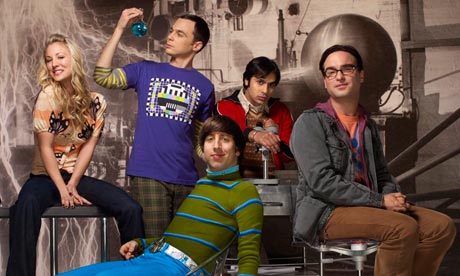
La serie televisiva Big Bang Theory potencia el nuevo boom de la Física

Asciende el interés por la física en estudiantes de bachillerato y primeros cursos universitarios gracias a la popularidad alcanzada por la serie de televisión Big Bang Theory.

Leer la noticia completa en : http://www.guardian.co.uk/education/2011/nov/06/big-bang-theory-physics-boom

Agradecimientos a Lucas Fernández Seivane por este magnífico post.

Big Bang Theory Staff

The Big Bang Theory attracted more than 500,000 viewers on its return to Channel 4. Photograph: Channel 4


A cult US sitcom has emerged as the latest factor behind a remarkable resurgence of physics among A-level and university students.

The Big Bang Theory, a California-based comedy that follows two young physicists, is being credited with consolidating the growing appetite among teenagers for the once unfashionable subject of physics. Documentaries by Brian Cox have previously been mentioned as galvanising interest in the subject.

One pupil, Tom Whitmore, 15, from Brighton, acknowledged that Big Bang Theory had contributed to his decision, with a number of classmates, to consider physics at A-level, and in causing the subject to be regarded as «cool». «The Big Bang Theory is a great show and it’s definitely made physics more popular. And disputes between classmates now have a new way of being settled: with a game of rock, paper, scissors, lizard, Spock,» he said.

Experts at the Institute of Physics (IoP) also believe the series is playing a role in increasing the number of physics students. Its spokesman, Joe Winters, said: «The rise in popularity of physics appears to be due to a range of factors, including Brian’s public success, the might of the Large Hadron Collider and, we’re sure, the popularity of shows like The Big Bang Theory

Alex Cheung, editor of physics.org, said: «There’s no doubt that TV has also played a role. The Big Bang Theory seems to have had a positive effect and the viewing figures for Brian Cox’s series suggest that millions of people in the UK are happy to welcome a physics professor, with a tutorial plan in hand, into their sitting room on a Sunday evening.»

According to the Higher Education Funding Council for England (HEFCE), there was a 10% increase in the number of students accepted to read physics by the university admissons services between 2008-09, when The Big Bang Theory was first broadcast in the UK, and 2010-11. Numbers currently stand at 3,672. Applications for physics courses at university are also up more than 17% on last year. Philip Walker, an HEFCE spokesman, said the recent spate of popular televisions services had been influential but was hard to quantify.

The number studying A-level physics has been on the rise for five years, up 20% in that time to around 32,860. Physics is among the top 10 most popular A-level topics for the first time since 2002 – and the government’s target of 35,000 students entering physics A-level by 2014 seems likely to be hit ahead of schedule. It is a far cry from 2005 when physics was officially classified as a «vulnerable» subject.

The number of those entered for AS level has also increased, by 27.8% compared with 2009, up from 41,955 to 58,190. The number of girls studying physics AS-level has risen a quarter to 13,540 and of boys by 28.6% to 44,650.

A Twitter debate on whether Big Bang Theory had played a role in encouraging more potential physicists provoked mixed reactions. PhD student Tim Green wrote: «I’d say it’s more to do with economics and good science docs than sitcoms with only the vaguest relation to physics.» Markela Zeneli said: «I think the show is hilarious, and it may make physicists seem nerdy and geeky, but what’s so bad about that? »

Winters identified another more prosaic reason for the rising popularity of physics. He said: «TV shows and news coverage of exciting research both have the power to inspire their audiences but we firmly believe, and all the evidence suggests, that only good physics teaching has the power to convert student’s latent interest into action.»
Nobel Prize in Physics

Three Astrophysicists Honored

Novel Medal photo

The 2011 Nobel Prize in Physics was awarded «for the discovery of the accelerating expansion of the Universe through observations of distant supernovae» with one half to APS Fellow, Saul Perlmutter (Lawrence Berkeley National Laboratory/UC-Berkeley), and the other half jointly to Brian P. Schmidt (Australian National University) and APS member Adam G. Riess (Johns Hopkins University).


More info in : http://www.nobelprize.org/nobel_prizes/physics/laureates/2011/press.html

Source: http://www.aps.org/

Jornadas para el Aprendizaje y la Enseñanza de las Matemáticas

Laboral Ciudad de la Cultura acoge las 15 Jornadas para el Aprendizaje y la Enseñanza de las Matemáticas del 2011 (15 JAEM). Se trata de un punto de encuentro para el debate, la reflexión y la formación sobre la enseñanza y el aprendizaje de las matemáticas, así como un espacio de intercambio y conocimiento mutuo de los profesionales de la Educación Matemática.

La Federación Española de Sociedades de Profesores de Matemáticas convoca estas Jornadas, que se celebrarán del 3 al 6 de julio.

Más info en aquí


Premios de Física de la Real Sociedad Española de Física y la Fundación BBVA

La Real Sociedad  Española de Física y la Fundación BBVA anuncian una nueva edición de los PREMIOS DE FÍSICA REAL SOCIEDAD ESPAÑOLA DE FÍSICA-FUNDACIÓN BBVA.

Estos premios, de periodicidad anual y ámbito nacional, reconocen la creatividad y la innovación en el campo de la Física, y pretenden servir de estimulo a los profesionales de esta disciplina científica que desarrollan su labor en los ámbitos de la investigación  —con especial atención a quienes inician su carrera— las enseñanzas secundaria y universitaria, la innovación y la tecnología, y la publicación de artículos de divulgación.

Categorías y Dotación
En esta convocatoria 2011, se concederán ocho premios en las categorías siguientes, con sus respectivas dotaciones económicas (*):

  • Medalla de la Real Sociedad Española de Física, premio dotado con 15.000 €.
  • Premio Investigador Novel en Física Teórica, dotado con 4.000 €
  • Premio Investigador Novel en Física Experimental, dotado con 4.000 €.
  • Premio Enseñanza y Divulgación de la Física (Enseñanza Universitaria), dotado con 8.000 €.
  • Premio Enseñanza y Divulgación de la Física (Enseñanza Media), dotado con 8.000 €.
  • Premio Física, Innovación y Tecnología dotado con 8.000 €.
  • Premio Mejor Artículo de Temas de Física en la Revista Española de Física (REF) o en la Revista Iberoamericana de Física (RIF), dotado con 1.500 €.
  • Premio Mejor Artículo de Enseñanza, Notas Históricas o Ensayos en la Revista Española de Física (REF) o en la Revista Iberoamericana de Física (RIF), dotado con 1.500 €.

(*) De las cantidades brutas indicadas se descontará el porcentaje estipulado por la normativa fiscal vigente.

Plazo y Lugar de Presentación de Solicitudes
Las candidaturas y apoyos a los premios mencionados se podrán remitir, por vía postal o por correo electrónico, a la secretaria de la RSEF:

Real Sociedad Española de Física
Facultad de Ciencias Físicas
Universidad Complutense de Madrid
Ciudad Universitaria s/n
28040 Madrid (España)
Correo electrónicorsef@fis.ucm.es
Teléfono: (+34) 91 394 43 59

El plazo de presentación de las candidaturas finaliza el 15 de junio de 2011.

EIRO forum. Encuentro entre profesores

EIROforum teachers school Dear Science in School subscribers, Many of you may be interested in the forthcoming teacher workshop given by EIROforum, the publisher of Science in School. The deadline for applications is fast approaching, so you will need to apply soon. This free, three-day course is entitled ‘Physics and chemistry of life’ and is open to European science teachers. It will take place at the European Photon and Neutron Science Campus.

Mas info en http://tinyurl.com/eiroschool

Thanks to Eleanor Hayes Editor-in-Chief of Science in School editor@scienceinschool.org http://www.scienceinschool.org